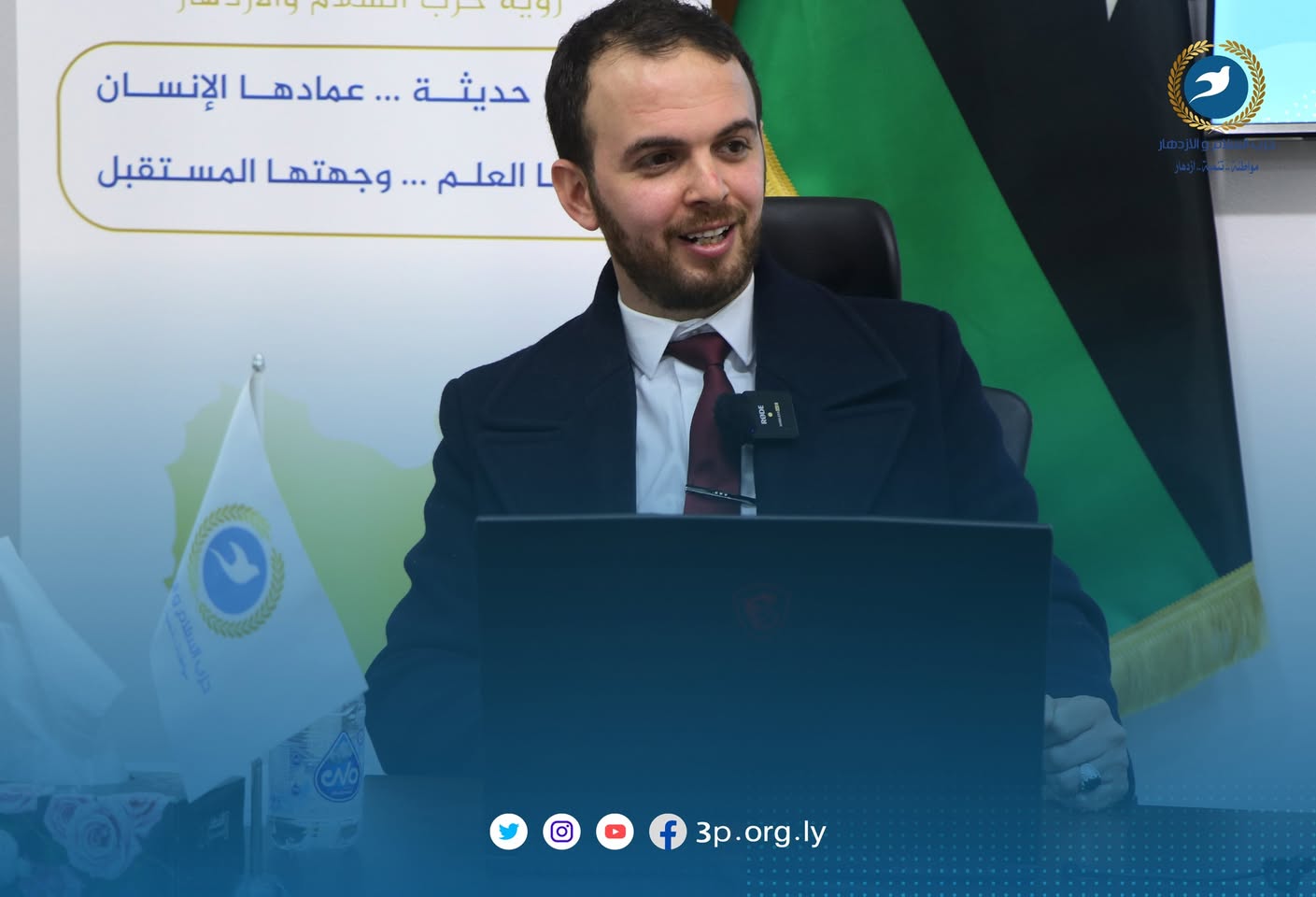
The Full Lecture
1. Opening Remarks and Acknowledgements
I thank the Peace and Prosperity Party for this generous invitation, and for its continued activity in organising lectures of this kind. I especially thank the party's president, Mr Mohammed Khaled Nuwayel, who kindly agreed to be one of the interviewees in the research for my Master's thesis; his answers were among the most important inputs to that thesis.
We chose to title this lecture "Issues and Themes in Public Administration and Public Policy in Libya," a subject that has preoccupied me since I first became interested in public affairs. When the February 2011 revolution broke out I was not yet eighteen, and at the time I did not view the matter through the lens of governing philosophy or the nature of the political system. I saw it in simple terms: we were looking at a resource-rich state whose services, education, health sector and administration were all failing to perform at the level required, wasting both money and time. That concern is what later led me to move from working as a civil engineer into the field of public policy.
2. Defining Public Administration and Public Policy
Before turning to the substance, it is useful to begin with a simple definition of the two foundational concepts: public administration and public policy.
Public administration is the "mechanical" part of the state — the apparatus responsible for implementing, supervising and following up on government policies, and for planning and organising the state's various operations, including infrastructure. The essential difference between it and private-sector business management is that its core objective is to serve the public interest; at the same time, it is the body that regulates private-sector activity, through institutions such as the Ministry of Economy, the Ministry of Trade and the chambers of commerce.
Public policy, meanwhile, is the set of laws, procedures and decisions issued by government bodies to address public issues. Both the legislative and executive branches share in shaping it: the legislature is responsible for enacting laws and the general legal framework, and the executive for implementation. The purpose of these policies is to solve societal problems and improve public welfare, and the process of formulating them passes through what is known as the "public policy cycle": problem identification, agenda-setting, formulating alternatives and decision-making, implementation, and evaluation. Among its key elements are the regulatory measures that ensure compliance, the allocation of resources for public services, and the involvement of various stakeholders in its formulation — what is known as the "democratisation of public policy."
A local example is worth noting here: during the al-Sarraj government, as far as we know, policy was discussed within a narrow circle of experts, without genuine consultation with citizens or a wider community of specialists — and it was therefore not democratic policy in the true sense. Sound public policy assumes that more than one alternative is put forward to address any given problem, and that these alternatives are assessed against objective criteria agreed upon by experts, while remaining dynamic and adaptable to society's needs.
3. The Difference Between "Politics" and "Public Policy"
We often use the single Arabic word "siyasa" to translate both "policy" and "politics," despite a fundamental difference between them, even though the two overlap considerably in practice. "Politics" concerns arrangements of governance and the use of power — essentially, who gets what, when, and how. "Policy," on the other hand, consists of principles that are adopted and translated into rules, laws and practical guidelines; it is the offer made to the general public — including those with no interest in playing the political game itself, but who care about good health, good education, and sound monetary and fiscal policy. In this sense, the structure of public administration and public policy may itself be the real source of the state's legitimacy in the eyes of its citizens.
The relationship between the two is close: politics, with the ideology it carries, is what shapes the public policy built upon it. The difference between the socialist and capitalist models during the Cold War, for instance, was clearly reflected in how services were delivered and social safety nets managed on each side. The final decision-maker in public policy is, in most cases, a political figure with their own agenda and electoral priorities — which makes it essential for that politician to be able to engage with technical detail, or to be surrounded by qualified advisory teams capable of assessing these policies and designing their implementation.
4. Why Public Administration and Policy Issues Matter
These issues matter because they are tied to citizens' civic participation, to holding government accountable for its performance, and to strengthening transparency and efficiency in government processes. They are also tied to supporting regional and international cooperation in addressing cross-border challenges — economic, social and security problems are often shared between Libya and its neighbours, such as Tunisia and Egypt — as well as to advancing fairness and equity, and to the optimal use of resources to achieve the greatest possible public benefit.
5. Public Administration, Public Policy, and State-Building
There is a direct relationship between issues of public administration and public policy and the question of state-building. Administrative reform is typically raised in the wake of any major transformation at the state level — which is precisely what should have happened in Libya immediately after the 2011 revolution, when the effectiveness and shape of the administrative apparatus should have topped the political agenda. Political structures and institutions without an effective administrative machine amount, in practice, to "a head without a body" — a state that delivers nothing tangible to its citizens.
The state-building literature points to two key factors that determine a state's success or failure: monopoly over the use of force, and service delivery. Service delivery specifically is what grants a state its legitimacy; when a state fails at this, there is essentially nothing left to justify the continued existence of the governing political body. Public administration and policy arrangements are also central to aligning peacebuilding efforts, both local and international, since both share the goal of restoring and improving basic services, strengthening the efficiency of state institutions, and shaping policies for economic recovery, social cohesion and infrastructure development.
6. The Central Theme: Evaluation, Improvement and Reform
When discussing issues of public administration and public policy, the central issue is always the same: evaluation, improvement, and reform. Responsibility for this evaluation does not rest with any single body — it is shared by everyone: the government apparatus, civil society organisations, citizens, the legislature, and trade unions. Any citizen who approaches a government office for a service, and then expresses satisfaction or frustration with its quality in everyday conversation, is in effect already conducting a form of public policy evaluation. The difference between this ongoing popular evaluation and the evaluation carried out by parties or civil society organisations is that the latter should be an objective assessment built on clear standards and indicators — not one built on personal approval or disapproval of whoever holds office.
Public policy issues reach the decision-maker's agenda through multiple channels: continuous cycles of evaluation and review conducted by research centres or unions, internal advisory teams working for the decision-maker, and public opinion expressed through demonstrations, social media platforms, or even artistic and dramatic works — as was the case with some Libyan drama productions in an earlier era, which shed indirect light on issues such as bribery and favouritism.
7. Secondary Issues
Beyond the central theme, there is a set of secondary issues worth discussing: the speed and quality of service delivery; governance, transparency and anti-corruption; the extent of stakeholder participation in policy-making; the relationship between the political and technical dimensions of the bureaucratic apparatus; and the impact of armed conflict on public administration — a research field in its own right, concerned with states that are experiencing or have experienced conflict. There are also questions of civil-service quality, employment, unemployment and the labour market — a central issue in Libya given the sheer size of the public-sector workforce — as well as public-budget management and economic priorities, and procurement, supply chains and development projects.
Also significant is the impact of "informal institutions and norms" on the performance of public administration — such as tribe and armed groups on one hand, or unwritten behavioural norms such as laxity around working hours or the spread of favouritism on the other. Notably, some countries perform well despite weak centralisation of their formal regulations, thanks to positive informal work values, while other countries with strict written regulations may still fail because a negative work culture hollows those regulations out in practice. This partly explains why some administrative systems built on a "goal-oriented" approach succeed, rather than ones built on strict adherence to formal working hours.
8. The Historical Context of Public Administration in Libya
The evolution of Libya's administrative apparatus is closely tied to the evolution of its civil service, given that the civil service is essentially what staffs the government structure.
Under the monarchy, Libya inherited a simple administrative structure from the period of British administration, proportionate in scale to the country's small population at the time. This structure developed gradually, particularly after the discovery of oil and the start of its marketing, with the assistance of a number of foreign experts.
Under the Qadhafi regime, the oil boom drove a major expansion of the state's administrative structure and of the number of departments and staff. The central turning point was the declaration of the "Authority of the People" — which, based on more than eight interviews I conducted for my Master's research, is nearly unanimously regarded by researchers and observers as the first point at which the effectiveness of public administration in Libya collapsed. When the head of an administrative body is chosen on the basis of political loyalty rather than competence, the result is legislative chaos — decisions issued and repealed repeatedly — and the criteria distinguishing between employees come to rest on length of service rather than actual competence. One need only listen to Qadhafi's own statements, in which he justified the chaos and seizure of others' property that followed the declaration of the Authority of the People by saying that "people overstepped," absolving himself of responsibility for having paved the way for that chaos through his own political and economic slogans, without holding those who committed the excesses to account.
A number of researchers have written important studies on public administration in Libya during that era, including Dr Alwa al-Fitouri and a Turkish researcher named Hamza Tash. Most agree that the first genuine collapse of public administration is tied to the declaration of the Authority of the People, and to a logic in which leadership of public institutions rested on loyalty rather than a demonstrated right to manage through competence — a mindset that persists today, since it is still rare to find someone who believes competence should be the standard for leading a public institution; more often, it is viewed through the lens of political or tribal priority.
9. The "Libya al-Ghad" Project and the Reform Attempt
The first serious reform attempts began in the early 2000s under what became known as the "Libya al-Ghad" (Libya of Tomorrow) project, which saw the appointment of a number of reform-minded officials, such as Shukri Ghanem, a review of the civil-service structure and staffing schedules, and the engagement of major international consulting firms — Monitor Group, Adam Smith International, McKinsey, Deloitte and EY — to assess the administrative bodies, the civil service, and related economic and political issues. These firms produced recommendations for sweeping reforms covering institutional development, strengthening the civil service, and improving decision-making processes.
However, the project, as the recommendations themselves noted, required parallel political reforms that never materialised, since the desired change in the effectiveness of public administration and public policy required a political structure capable of absorbing such transformations. I prepared a university research paper systematically evaluating this experience, and concluded that it was a failed attempt, in that its stated objective was never achieved. A European researcher, Alice Berger, discussed in a research paper the absence of genuine political will behind the project: Qadhafi himself repeatedly backtracked on the reforms he was said to champion, the project faced opposition from what was known as the "Old Guard," and there were doubts about Saif al-Islam Qadhafi's ability to lead this track to full effect.
10. The Accumulated Negative Legacy and the Impact of Post-2011 Conflict
After the February 2011 revolution broke out, Libya lacked an organised and sustainable political and constitutional framework. If the role of the Revolutionary Committees under Qadhafi can be described as an "informal institution" of political influence, what replaced them after 2011 was, first and foremost, armed formations, followed by an unprecedented surge in the influence of tribal, regional and local affiliation. This was no longer confined to demands for shares of ministerial posts, but extended to sub-departments within ministries themselves, through pressure and coercion exerted on institutions in matters of resource allocation, hiring, and development projects. As a result, even technical and bureaucratic institutions lost the ability to set their own agenda and plans objectively and independently.
The impact of armed conflict and security problems disrupted foreign investment and weakened the private sector and oil production, which in turn affected the financial resources available for any genuine reform project. Reducing the number of civil-service employees, for example, necessarily requires an alternative social safety net, adequate funding for it, and security and political stability that would allow the private sector to absorb these numbers — conditions that are simply not available at present, making genuine reform difficult to achieve under current circumstances.
11. The Numbers and the Data
The figures clearly reflect the scale of this inflation: the number of public-sector employees rose from around 900,000 in 2011 to between 2.3 and 2.6 million today, according to different sources — the Audit Bureau on one hand and the Central Bank on the other. The first chapter of the general budget (salaries) rose from roughly 9 billion dinars in 2010 to around 17 billion dinars in 2012, then to about 50 billion dinars in 2022, reaching roughly 60 billion dinars in 2023 — an increase that did not happen all at once, but in successive waves, most notably the jump from about 25 billion dinars in 2020 to 60 billion dinars in 2023.
Meanwhile, the state continues to rely on oil revenues for more than 90 percent of total revenue, while the contribution of all other sectors combined does not exceed 10 percent — a ratio that has barely changed over the past decade.
12. Key Public Policy Issues in Libya Today
If we set aside, for argument's sake, the question of "who governs" and the political philosophy of governance arrangements and the constitution, and focus purely on the technical side of running the state, the most pressing issues today include: the size of administrative structures and the effectiveness of public administration institutions and the relationships between them; the size, role and effectiveness of the civil service; the management of the public budget and expenditure, and the balance between the scale of administrative structures and the level of government spending; and the impact of conflict on public administration, public policy, and development.
Another prominent issue is the role of informal institutions: tribe, armed formations, and cross-border organised-crime networks involved in fuel, drug and human smuggling, some of which have taken on an official status within state bodies. This makes local governance and legislative representation a central concern, given the growing risk that the "barons" of these networks could come to dominate the political scene in any future electoral process, especially given their ability to mobilise local social support.
13. What Genuine Reform Requires
Even where political consensus and the will needed to pursue genuine reform exist, a major challenge remains — specifically, "change management." The informal culture prevailing among public-sector employees cannot be changed by top-down decree; it requires carefully designed programmes and a deliberate choice between a measurable, gradual approach to change and a sudden, "shock therapy" approach.
My Master's research on civil-service reform in post-conflict states — Libya being one of them — concluded that no genuine reform can be implemented without political will, since the final decision-maker, whether by authorising the movement of funds or the deployment of security forces, is the political actor. Social mobilisation can exert pressure that leads to political change, and, in theory, international intervention could exert similar pressure — but any external actor still needs a local partner in power who has a vision, priorities, and the capacity to implement — something that is often unavailable.
Assuming political will exists, any genuine reform track, particularly on the civil-service file, requires a number of steps. First, genuine community consultation, given that administrative reform carries direct financial and livelihood consequences for people, and given that some informal practices — such as tribal affiliation as a hiring criterion — are culturally entrenched; this dialogue should be treated as an integral part of the national reconciliation process. Second, genuine risk management, particularly the provision of an actual social safety net for those who might be affected by any reduction in staff numbers — and not only through the Ministry of Labour, but also for those effectively working in parallel across both the public and private sectors. Third, transparency in how the policy itself is formulated: any announced policy to reduce the public payroll, for example, should be built on a sound public-policy cycle in which the problem is clearly defined, multiple alternatives are put forward and assessed against clear political, social and financial criteria — rather than presented as a vague, unilateral decision without genuine discussion with stakeholders. Fourth, drawing on successful local models: some sectors, such as telecommunications, have developed an administrative structure built on clear job descriptions and disciplined hiring and procurement procedures — models that could gradually be extended elsewhere. Fifth, tailoring any reform programme specifically to the Libyan context, rather than importing ready-made programmes implemented in entirely different political and social contexts, such as Indonesia or Nigeria, while subjecting any reform programme to continuous evaluation that limits the impact of partial setbacks and prevents wholesale abandonment of the reform track. Sixth, building an accurate and reliable information and archiving system — since the wide discrepancy in official figures on the number of employees, and the absence of precise classification by age, skill, qualification and job type, makes it impossible to design an accurate and fair reform policy, as the right solution may not be the same for every category of employee.
14. Closing: Who Should Lead the National Dialogue?
Drawing on my own experience since 2011 in community work and youth initiatives, I have observed that public engagement with any given issue usually requires one of two things: either popular momentum or public anger — and the trouble with anger is that it tends to be temporary. Teachers' unions, for instance, mobilise forcefully when it comes to salary increases, but rarely show the same momentum when it comes to reforming the curriculum or building a genuine system to support scientific research. The same applies to student union activity, which moved from genuine momentum after the 2011 revolution to a reality in which, at some universities, factions loyal to military or armed formations now hold sway.
At its core, national dialogue needs a project; a project needs activities; and activities need resources — resources that either the state and its institutions fund out of a genuine desire for reform, or that citizens themselves bear. I don't believe there is a final, definitive answer to the question of who should lead this dialogue. But a realistic starting point could be persuading professional unions specifically — since a citizen is never simply an abstract individual, but also an engineer, a lawyer, or a teacher — alongside political parties, civil society organisations, and the frameworks that represent different social constituencies, so that a shared vision emerges around the shape of the state itself, not merely around who governs it.
Finally, continuing to paper over immediate problems with short-term fixes — such as marriage-support funds, or unconditional salary increases — without addressing the underlying dysfunction in the structure of public administration and public policy, will only lead to further waste. Libya, with the human and material resources it possesses, deserves a future far better than the one in which we currently find ourselves.
← Back to blog